Automated Bakery Line Engineering
Commercial Strapped Pan Sets: Line Compatibility and Buyer Specification Guide
A B2B guide to specifying strapped pan sets by envelope, datums, frame construction, automation interfaces, stacking, drainage and line trials.
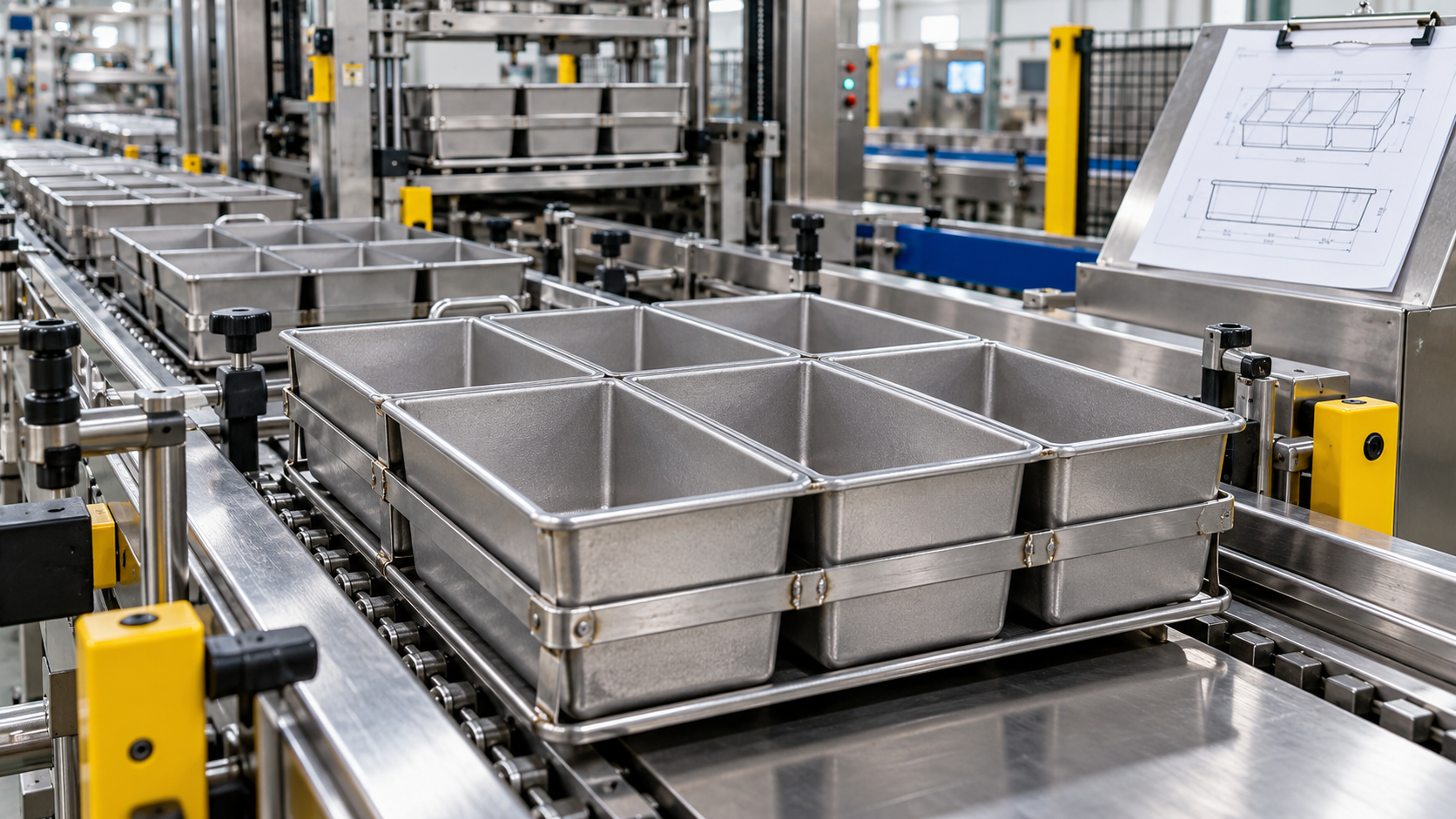
Map the complete pan route before approving a design
Document every interface from pan storage and unstacking through greasing, depositing, proofing, oven loading, depanning, cleaning, inspection and restacking. A strapped set that fits the oven can still fail at an indexer, magnetic transfer, lid station, depanner or washer.
Record the line manufacturer, equipment model, conveyor elevation, direction of travel, orientation changes, cycle rate and known contact points. Mark which dimensions are fixed by equipment and which can be adjusted during commissioning.
Lock the outside envelope, datums and pitch
Control overall length, width and height as assembled dimensions, not as the sum of nominal cavity sizes. Define the primary locating faces, centerlines, cavity pitch, corner clearances, squareness and allowable twist so the supplier and equipment integrator inspect the same geometry.
Include a loaded condition where dough weight, lids or thermal growth can change how the set presents to guides and sensors. State measurement temperature and support method for any tight flatness or diagonal tolerance.
Specify the frame and pan-to-strap connection
Choose the perimeter band, cross rails, bumpers and attachment method around the real duty cycle. The buyer should review joint accessibility, sharp-edge control, replacement strategy, coating coverage, fatigue exposure and whether the construction creates soil traps.
Do not approve a frame by material thickness alone. Ask for section shape, material grade, rail spacing, connection detail and a drawing of every automation contact area. Protect cavity walls and pan bottoms from impacts during stacking and transfers.
Engineer the automation contact zones
Identify where side guides, stops, lift fingers, magnets, clamps, vacuum depanners, panner bars, lid locators and sensors touch or detect the set. Reserve clear, repeatable contact zones that remain functional after coating, normal wear and minor service straightening.
AMF describes automated pan handling around stacking, unstacking, storage, cleaning, conveying and lidding. Treat these as a connected system: a rail or bumper change intended for one station can alter magnetic pickup, sensor visibility or downstream stack stability.
Validate stacking, nesting and storage behavior
Define stack orientation, maximum stack height, support points, vertical pitch and allowed lean. Confirm that an upper set cannot load coated food-contact surfaces or jam around bent corners. Include pallets, pan trucks, automated storage and manual recovery in the review.
Run repeated stack and unstack cycles at production speed. American Pan notes that commercial pan designs may use interlocked straps and nesting features to support sanitation, drainage and safe storage; buyers should validate equivalent claims on the exact production-intent set.
Check heat flow, washing and drainage as one design problem
Rails and bands can shield heat, collect water or block cleaning spray. Review cavity spacing, circulation openings, drain paths and hang-up points with the oven and washer route. Avoid pockets that retain water, crumbs, release agent or cleaning chemistry.
Trial both cold and hot sets after repeated bake-and-wash cycles. Inspect for distortion, loose joints, coating rub, corrosion at connections, trapped residue and changes in stack height or conveyor tracking.
Approve with production-intent trials and controlled evidence
Use a signed interface drawing, inspection plan and trial protocol. Test the full set at target speed with representative dough, lids and cleaning conditions; record jams, sensor misses, depanning performance, transfer marks, stack quality and dimensional change.
Freeze the approved drawing revision, material and coating systems, joint construction, critical dimensions and inspection method. Require written change approval before the supplier alters a strap, rail, attachment, coating build or manufacturing process that can affect line fit.
Strapped Pan Set Interface Approval Matrix
| Interface | Buyer supplies | Approval evidence |
|---|---|---|
| Conveying and indexing | Direction, speed, guides, stops and datum faces | Dry-cycle video and jam log |
| Depositing and depanning | Cavity pitch, orientation and pickup clearance | Product trial and release record |
| Oven and cooling | Temperature route, support points and thermal clearance | Hot dimensions and tracking result |
| Washing and sanitation | Spray direction, chemistry, drainage and dry-off route | Post-wash inspection and residue check |
| Stacking and storage | Stack pitch, height, pallet or truck and recovery method | Repeated stack/unstack trial |
| Change control | Critical characteristics and approval owners | Signed drawing and inspection plan |
Industry references: AMF pan and lid handling systems for connected automation interfaces; American Pan Auto-Bake trays for examples of interlocked straps, nesting, sanitation and drainage features. Validate all requirements on the buyer's exact line.
Frequently Asked Questions
What is a strapped pan set?
It is a group of individual bread or loaf pans joined by a common frame or strap system so the bakery line handles them as one repeatable production unit.
Which dimensions are most important for automated lines?
Overall assembled length, width and height, locating datums, cavity pitch, squareness, flatness or twist, rail and bumper positions, stack pitch and all equipment contact zones are usually critical.
Should the bakery or pan supplier define the interface?
The bakery, equipment integrator and pan supplier should approve one shared interface drawing. The bakery owns the route requirements, while the supplier must show how the production pan set meets and can be inspected against them.
How should a strapped set be trialed?
Run production-intent sets through every relevant station at target speed, hot and cold where applicable, then repeat bake, wash, depanning and stacking cycles before freezing the design.
Can an existing pan set be copied from a sample?
A sample is useful, but it should be measured and converted into an approved drawing with stated tolerances, materials, coatings, joint details and revision control. Wear or distortion in the sample must not become the new specification.
Engineering Review
Specify the pan set around the complete line.
Send the existing pan-set drawing or sample dimensions, line equipment list, cavity layout, product weight, coating requirement, washer route, stacking method and target quantity. Bakeware China can prepare a production-intent drawing and trial plan for review.
When pans will enter an automated return loop, use the commercial bakeware stacking and unstacking automation guide to align stack geometry, pickup zones, sensors, recipes and sustained line trials.