Blog / Industrial Loaf Pan Sourcing
Commercial Loaf Pan Specifications: A Buyer's Guide for Industrial Bakeries
Specify commercial loaf pans and strapped sets by bread target, cavity geometry, line interfaces, materials, coating, trials and inspection.
Bakeware China Editorial Team | 2026-07-29 | 10 min read
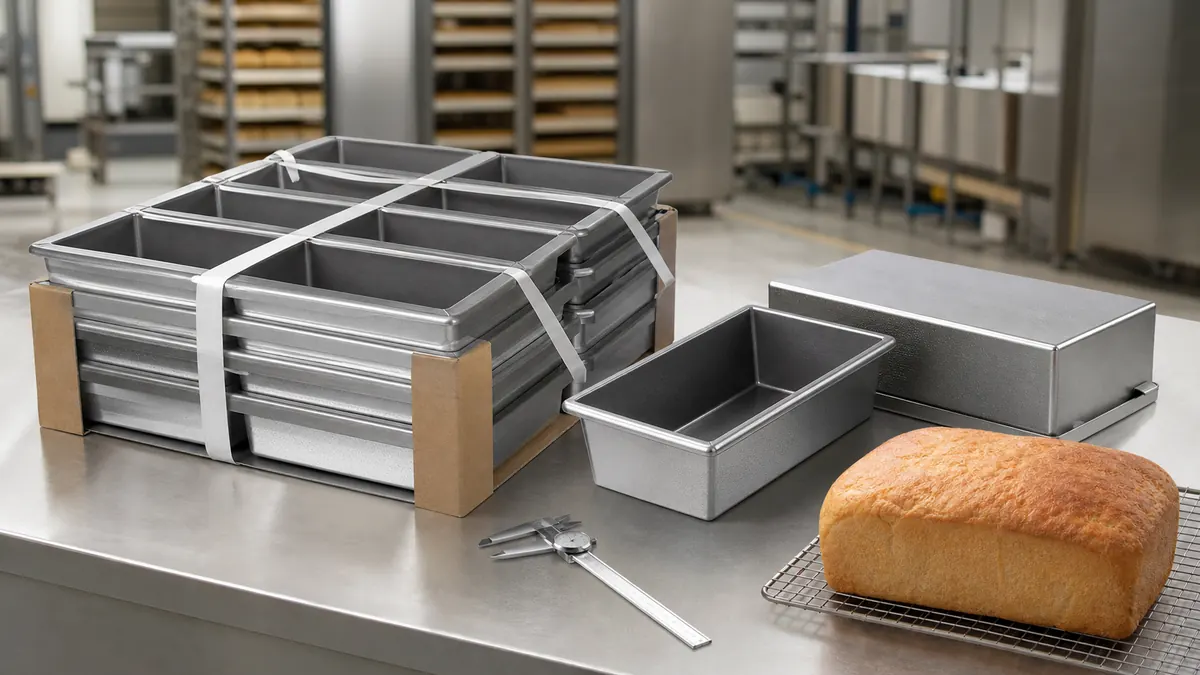
Translate the finished loaf target into a cavity brief
Start with the bread, not a catalog pan name. Give the supplier the target loaf mass, finished length, width and height, slice format, sidewall profile and whether the top should be domed or square. Add dough type, scaling-weight range, proof level and bake profile. These inputs let the bakery and pan supplier develop cavity dimensions for a controlled trial; they do not create a universal dough-weight-to-pan-volume formula.
Put internal top and bottom dimensions, depth, corner radii, wall angle and corrugation on a drawing. State where each dimension is measured and whether it applies before or after coating. If an existing loaf must be matched, send a verified pan drawing and sample loaf rather than relying only on nominal labels such as 1 lb, Pullman or sandwich bread.
Choose single pans, strapped sets and lids around the process
A single loaf pan can suit manual handling, development work or flexible batches. Strapped loaf pan sets hold several cavities at a fixed pitch for rack loading or mechanized handling. Specify cavity count, row arrangement, center-to-center pitch, overall envelope, strap position, lifting points, nesting behavior and maximum acceptable mass.
For square-top bread, define the Pullman lid as part of the system. Record lid material, engagement direction, stop or retention feature, clearance after heating and the line step where lids are fitted and removed. Do not assume a lid from one pan revision will interchange with another unless the mating dimensions and trial confirm it.
Map every bakery-line and rack interface
Document contact with conveyors, indexers, proofers, ovens, depanners, lid handlers, washers, stackers and oven racks or trolleys. Identify datum edges, rails, stops, sensors, magnets, grippers and vacuum tooling. The equipment owner or integrator should provide the usable operating window; the pan drawing should identify the dimensions and inspection methods that keep the set inside that window.
OSHA bakery-equipment rules address machinery design, installation, operation, maintenance and guarding. A pan trial must follow the bakery safeguarding, lockout and operating procedures. Pan geometry should be validated through each transfer without bypassing guards or treating a supplier sample as authorization to alter the line.
Specify construction, food-contact evidence and cleaning
Define base-metal grade, thickness, formed rim, reinforcement, straps, weld or fastening method, surface preparation and coating zones. Ask the supplier to explain how the construction supports the proposed cavity and set geometry, but avoid unsupported service-life or heat-performance claims. Review the separate commercial bakeware coating specification before freezing a finish.
FDA includes processing equipment, food-preparation surfaces and cookware within food-contact articles, and its conditions-of-use reference distinguishes bakery foods and cooking above 250°F. For EU programs, Regulation (EC) No 1935/2004 covers articles intended or reasonably expected to contact food and requires traceability. NSF food-equipment standards cover material safety and cleanability, but an unverified loaf pan must not be described as NSF certified.
Approve production-representative pans in the real process
Trial pans should use the intended metal, tooling route, straps, fasteners, preparation, coating and cure process. Run scaling, depositing or molding, proofing, lidding, baking, depanning, cooling, washing, stacking and storage. Record loaf dimensions and appearance, sticking, pan movement, lid behavior, residue, visible damage and line stoppages against written acceptance criteria.
Separate product approval from equipment-interface approval: acceptable bread does not prove reliable conveying, and smooth conveying does not prove the loaf target. Freeze the approved drawing revision, sample ID, recipe and process window used for evaluation. Trial findings apply to those conditions rather than guaranteeing performance for every formula, temperature or cleaning method.
Build inspection and repeat-order controls into the RFQ
Identify critical dimensions and how they will be measured: cavity top and bottom, depth, pitch, overall envelope, lid fit, set flatness and relevant strap locations. Add workmanship criteria for sharp edges, contamination, exposed metal, coating coverage, welds or fasteners, and packing protection. Agree the sample size or inspection plan instead of assuming every feature is checked on every pan.
The purchase specification should reference the drawing, approved sample, material and finish records, packaging, lot identification and change-control route. Require notice before changes to tooling, metal, coating, cure, strap construction, fasteners or production location. Send the completed brief through the custom baking pan RFQ or use the supplier checklist.
Commercial Loaf Pan RFQ Checklist
| Specification area | Buyer input | Approval record |
|---|---|---|
| Bread target | Loaf mass, dimensions, profile and slice format | Approved loaf and process window |
| Pan geometry | Cavity dimensions, pitch, set envelope and lid | Controlled drawing |
| Interfaces | Line, rack, gripper, sensor and washer contacts | Equipment trial record |
| Construction | Metal, straps, fasteners, coating and zones | Approved sample and material records |
| Production control | Inspection, packing, lot ID and change control | Purchase-order attachment |
FAQ
What information is needed to quote commercial loaf pans?
Provide the target loaf, dough and process, cavity drawing, quantity, single or strapped format, lid, material and finish, line and rack interfaces, cleaning method, destination market, inspection needs and packaging.
How many cavities should a strapped loaf pan set have?
There is no universal count. Select it from the usable oven or rack envelope, line pitch, handling mass, throughput plan and validated equipment interfaces.
Can nominal loaf weight determine the exact pan size?
No. Formula, scaling weight, proof, shape and bake process affect the result. Use the loaf target to develop a drawing, then approve it through a representative bake trial.
When is a Pullman lid required?
Use a lid when the product and process require a controlled square top. Specify its engagement, clearance, retention and handling interfaces with the pan.
Should a buyer approve bread quality or line fit first?
Approve both with production-representative pans. Product results and equipment compatibility are separate acceptance gates and neither substitutes for the other.
Call to action: Planning a new sandwich-bread line or replacing a loaf-pan fleet? Send your target loaf, cavity or sample-pan drawing, dough and bake process, line and rack interfaces, lid requirement, cleaning method, destination market and order quantity for a specification review and quotation.