Blog / Commercial Sourcing and Compliance
Commercial Bakeware Supplier Checklist: What OEM Buyers Should Verify Before Ordering
Use this commercial bakeware supplier checklist to verify food-contact documentation, samples, tooling, inspection points and packaging before placing an OEM order.
Bakeware China Editorial Team | 2026-07-15 | 6 min read
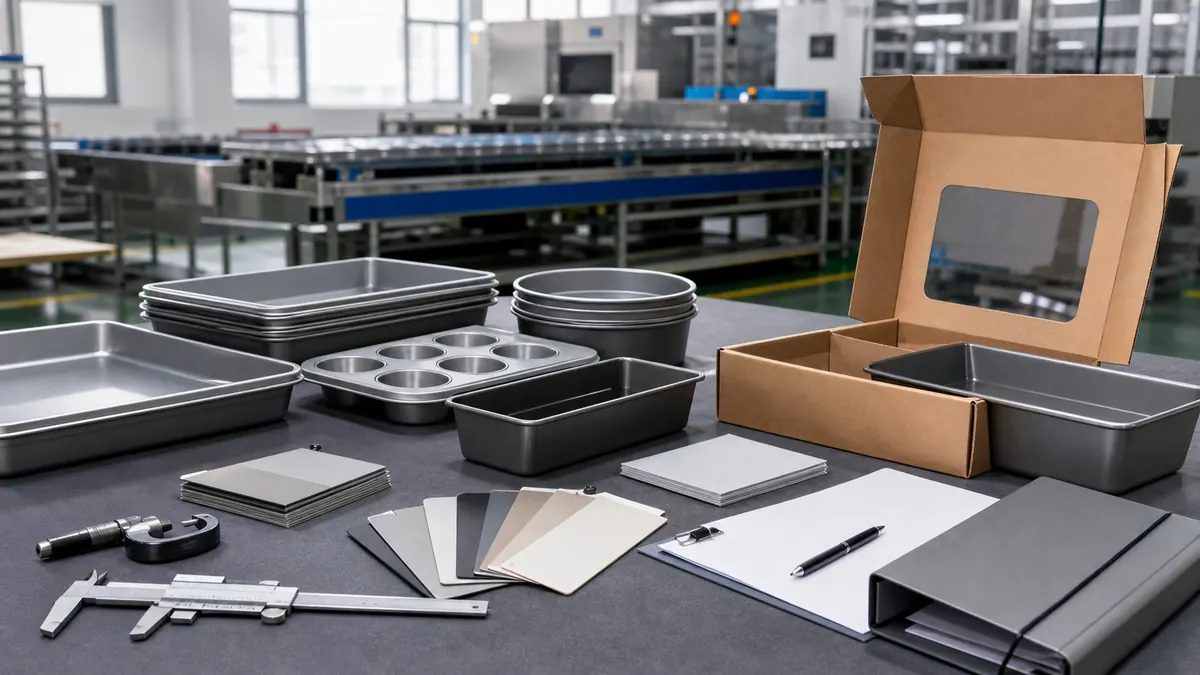
Start with the exact product scope, not a broad catalog claim
A commercial bakeware project should begin with a clear definition of the ordered item: pan type, dimensions, wall height, material, thickness, coating, rim or frame structure, and intended bakery use. Many sourcing mistakes happen because the buyer approves a general product family while the factory prices a different construction standard.
Ask the supplier to confirm the legal company name, production location, and which steps are completed in-house or subcontracted. For custom programs, match the quotation with the same drawing revision and processing route shown on the custom baking pans and manufacturing pages so tooling, coating and packing assumptions are not left open.
Check food-contact compliance by destination market
Do not rely on generic statements such as food grade or export quality. For the United States, buyers commonly review documentation against the applicable FDA food-contact framework for the exact substrate and coating system. For the European Union, buyers typically check whether the supplied materials are supported for food-contact use under the relevant framework and good manufacturing practice requirements. In both cases, the exact item, coating and intended use matter more than a broad company claim.
Request current documents for the exact combination being ordered: base metal, non-stick or silicone coating, release system if used, and destination market. Verify the issuer, scope, product description and document date. If your distributor or factory customer needs a declaration of compliance or migration-related support, ask that question before sampling rather than after the production order is released.
Make sample approval match the real production route
A useful sample is not only about shape. Buyers should confirm whether the sample uses production tooling, production-thickness material, the intended coating system, and the same edge, weld or frame construction planned for bulk supply. If the sample is hand-finished, soft-tooled or packed differently, record those differences in writing before approval.
Create an approval sheet that covers drawing revision, cavity size, flatness, coating appearance, release expectations, nesting or stacking fit, carton marks and any special handling requirements. The practical checkpoints described on the case study and FAQ pages are a useful baseline for commercial review.
Lock inspection, packaging and change control before deposit
Before mass production starts, define how the order will be checked and what counts as acceptable. That usually includes dimensional checkpoints, coating appearance standards, weld or frame review, stackability, count per carton, carton protection and pallet or loading instructions where applicable. If the order is for a distributor or private-label program, include barcode, inner pack and outer carton rules in the same file set.
Change control is equally important. Put the approved drawing, sample revision, material callout, coating description, packaging method and shipment terms into the purchase order or attached specification. If the factory needs to change a substrate, coating supplier, packing method or tooling detail, require written approval first. That protects both the buyer and the supplier from preventable disputes.
Supplier Qualification Checklist
| Checkpoint | What to confirm | Why it matters |
|---|---|---|
| Product definition | Drawing revision, dimensions, material, thickness and coating | Prevents quotation gaps between sample and production |
| Compliance file | Exact substrate and coating documents for the destination market | Reduces food-contact and import-document risk |
| Sample route | Whether the sample uses production tooling and production finish | Avoids approving a sample that does not match mass supply |
| Inspection and packing | Dimension checks, coating appearance, carton rules and pallet plan | Protects product consistency and shipment condition |
FAQ
What documents should I request from a commercial bakeware supplier?
Request documents tied to the exact product and market, such as material or coating support records, any needed declarations, approved drawings, sample records, inspection criteria and packaging specifications.
Does one food-contact report cover every baking pan?
No. Coverage depends on the exact substrate, coating system, intended use and destination market, so buyers should verify the scope of each document instead of assuming it applies to all items.
How should I approve a custom bakeware sample?
Approve the sample against a written checklist that covers drawing revision, dimensions, thickness, coating, structure, nesting, packaging and any differences between sample construction and mass production.
What should distributors add to the purchase order?
Distributors should add labeling rules, packaging configuration, barcode or carton-mark requirements, inspection checkpoints, approved sample reference and a written change-control requirement.
Call to action: Need a second review of your bakeware specification, compliance document list or sample checklist? Send your drawing, target market and order plan for a practical quotation review.