Blog / Commercial Bakeware Coatings
Commercial Bakeware Coatings: How Buyers Should Specify and Validate Them
Build a commercial bakeware coating specification covering product, process, food-contact documents, samples, inspection, cleaning and change control.
Bakeware China Editorial Team | 2026-07-24 | 9 min read
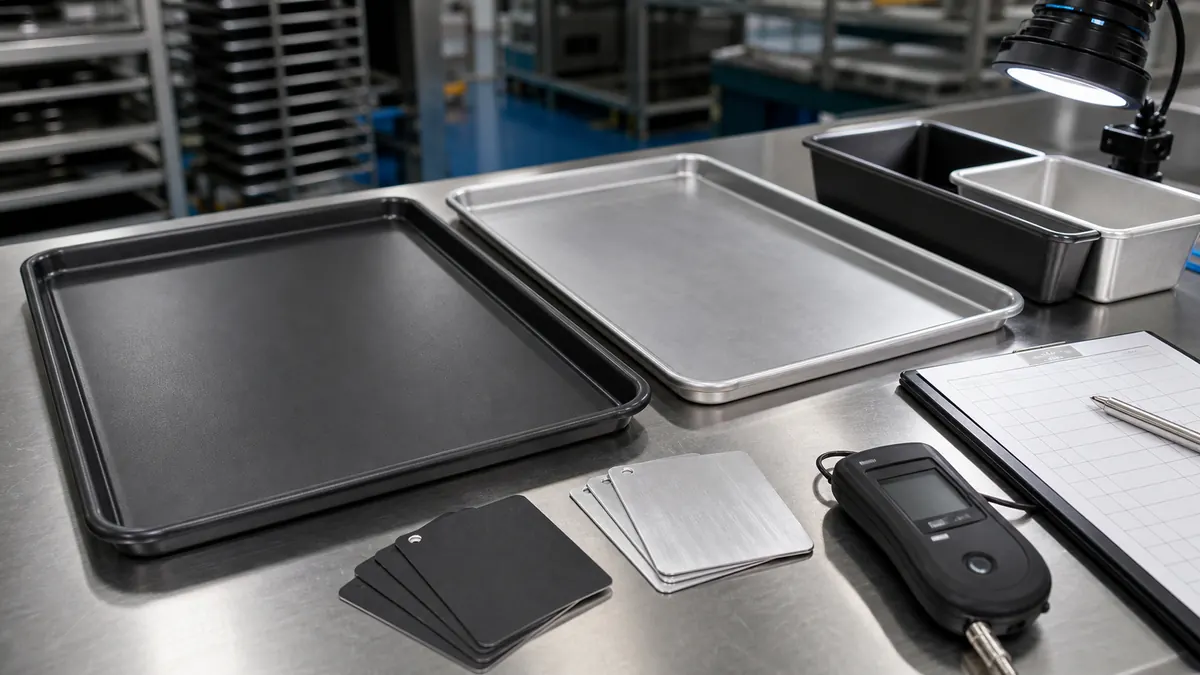
Start with the bakery process, not a coating name
A commercial bakeware coating specification should begin with how the pan will actually be used. State the product family, dry or oily surface, dough or batter contact, typical and maximum pan temperatures, bake time, release agent, depanning method, cooling sequence and cleaning process. Identify metal scrapers, pan washers, conveyors, nesting and rack contact that may affect the finish.
Names such as non-stick, silicone glaze, fluoropolymer or anodized finish do not by themselves define a workable system. The same coating family can be formulated, prepared, applied and cured in different ways. Ask the supplier to recommend a construction against the written duty cycle, then record the exact approved system on the quotation and sample record.
Define the substrate and surface preparation together
Coating performance depends on more than the top layer. Base metal grade and thickness, forming route, welds, rim construction, surface preparation and cure schedule form one system. A finish proven on one substrate or pan geometry should not automatically be assumed equivalent on another. Compare anodized and regular aluminum and use the supplier checklist.
Mark food-contact surfaces, exterior surfaces, masked zones and areas that must remain uncoated for welding, sensing, grounding or gripping. Do not use color alone to identify an existing finish. Record the substrate, finish identity and sample revision the supplier must reproduce.
Request food-contact evidence for the exact intended use
FDA treats cookware and processing surfaces as food-contact articles and links authorization to intended use. Its conditions-of-use tables distinguish bakery products and high-temperature cooking. Request evidence matching the exact coating, substrate, food contact, temperature and market.
For the EU, the food-contact framework and GMP rules emphasize intended use, traceability and controlled manufacture. Confirm current requirements before ordering, and make no certification claim beyond supplied evidence.
Turn release and durability expectations into a trial plan
Release is a system outcome affected by recipe, surface condition, proofing, bake profile, release agent and depanning. Replace vague requests for excellent release or long life with a representative test plan defining product, line settings, trial cycles, cleaning interval, inspection points and review triggers.
Use production-representative pans made with the intended substrate, preparation, coating and cure route. Test loading, baking, depanning, cooling, washing and stacking. Record sticking, residue, visible damage and dimensional changes. Results belong to the tested process; they are not a universal service-life guarantee.
Specify inspection, cleaning and handling controls
Agree how incoming pans will be checked: coverage, contamination, blisters, exposed metal, runs, chips, relevant color range, masked areas and dimensions after curing. Define lighting, viewing distance, sampling and a reference sample. Add packing protection where pan contact could mark the finish in transit.
Give the supplier the washer type, detergent and concentration range, water temperature, contact time, rinse and drying conditions. Disclose abrasive pads, metal tools or caustic cleaning used in the real process. Request written care limits for the supplied finish rather than assuming a universal cleaning rule.
Lock the approved system and require change control
After trial, freeze the drawing revision, base metal, preparation, coating product or controlled equivalent, appearance reference, application zones, cure controls, approved sample, inspection, cleaning limits and packaging. If details are proprietary, require a stable supplier-controlled specification supporting traceability.
Require written approval before changes to substrate, coating source or formulation, preparation, cure process, production location or evidence. Send these inputs with the custom baking pan drawing and review the manufacturing route before quotation.
Commercial Bakeware Coating RFQ Checklist
| Area | Buyer input | Approval record |
|---|---|---|
| Use conditions | Food, temperature, bake, release and depanning | Written duty cycle |
| Construction | Substrate, preparation, coating and zones | Drawing and controlled specification |
| Compliance | Market and intended food-contact use | Evidence matched to construction |
| Validation | Product trial, cleaning and criteria | Approved sample and trial report |
| Production | Inspection, packing and change control | Purchase-order attachment |
FAQ
What belongs in a commercial bakeware coating specification?
Include substrate, coating system, application zones, food and temperature conditions, release, cleaning, compliance evidence, trial plan, inspection, approved sample and change control.
Is a non-stick coating name enough for an RFQ?
No. A family name does not define preparation, formulation, coverage, cure route, intended use or acceptance criteria.
Can a supplier guarantee a fixed number of bake cycles?
Only a claim tied to matching test conditions and acceptance criteria is meaningful. Treat results as specific to the tested bake, release, cleaning and handling process.
What food-contact documents should a buyer request?
Request evidence tied to the exact substrate-and-coating combination, intended food, condition of use and destination market; verify issuer, scope, date and product identity.
When should the coating specification be frozen?
After production-representative samples pass the agreed bakery and cleaning trial, and before mass production.
Call to action: Comparing coatings for a new pan program or replacing a worn fleet? Send your pan drawing, product, bake profile, release method, cleaning process, destination market and target quantity for a coating-and-construction quotation review.