Blog / Automated Bakery Line Engineering
How to Specify Commercial Baking Trays for an Automated Bakery Line
Learn which commercial baking tray specifications to lock before trials: envelope, datums, rim geometry, material, coating, perforation and inspection.
Bakeware China Editorial Team | 2026-07-22 | 8 min read
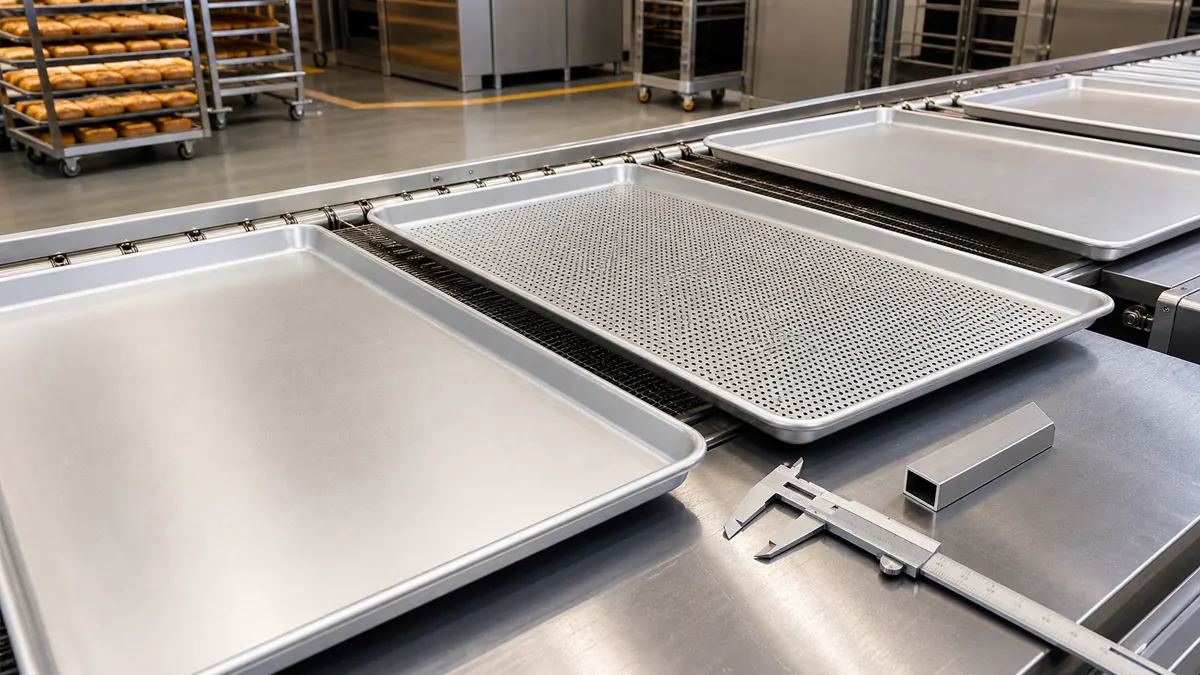
Map every tray contact point before requesting a quotation
An automated line handles a tray at conveyors, loaders, depositors, depanners, cleaners and stackers—not only inside the oven. A dimension that seems unimportant at the oven can become critical at a transfer. Map every rail, belt, stop, sensor, magnet, vacuum head and mechanical finger. Confirm oven and proofer openings plus rack and trolley clearances. The integrator should define interfaces; the pan supplier should build and inspect to the approved drawing.
Build the drawing around datums, not nominal size alone
Separate the maximum envelope from functional dimensions. Identify the datum edge or surface used by the line, then dimension rim width, corner radius, flange height, bottom footprint, cavities and frame members from it. State the measurement condition. Do not copy tolerances from another project: ask the equipment maker for its allowable operating window, identify critical dimensions and put the inspection method on the drawing.
Specify construction for handling, baking and sanitation together
Material grade and thickness affect mass, stiffness, heat response and forming limits, while rims, wire, frames, welds and corners affect stability and nesting. Compare sheet pans, bun pans and baguette pans. NSF describes food-equipment standards through material safety, design, construction and cleanability, but an unverified tray must not be called NSF certified. Define market documents and cleaning conditions explicitly.
Treat coating, perforation and release as process variables
Identify the approved coating system or performance specification, finish range, application areas and inspection criteria. Mark zones that must remain uncoated for grounding, sensing, welding or gripping. Request food-contact support for the exact substrate-and-coating combination and intended market. Dimension perforation diameter, pitch, boundaries and orientation from the datums. Validate dough, proofing, bake profile, release agent, coating and depanning together; no finish is a universal guarantee.
Run a staged line trial before approving production
Use production-representative trays to test conveying, accumulation, indexing, loading, oven transfer, depanning, cooling, cleaning and stacking. Run enough cycles to expose thermal movement, residue and nesting behavior, then reinspect at room temperature. Follow guarding, lockout and operating procedures; OSHA bakery-equipment rules include machine-guarding requirements. Freeze the drawing revision, sample, materials, finish, inspection points, packing and change control after approval. See custom baking pans and manufacturing for RFQ inputs.
Automated Line Tray Specification Checklist
| Interface area | Input | Approval evidence |
|---|---|---|
| Conveying | Envelope, datums, rim and bottom footprint | First-article report and empty-line trial |
| Loading and depanning | Product layout and gripping zones | Loaded product trial |
| Oven and cleaning | Material, finish, perforation and cleaning conditions | Thermal and cleaning trial |
| Stacking | Nesting stops, stack pitch and mass range | Stacker trial |
FAQ
Which tray dimensions matter most?
Those used by conveyors, stops, loaders, depanners, cleaners and stackers—often envelope, datum-to-rim dimensions, flange height, corners, bottom footprint, flatness and stacking pitch.
Standard or custom trays?
Use standard only when its verified drawing fits every interface and process. Choose custom when line, product, nesting or handling geometry requires it.
How many trial trays?
There is no universal number. The integrator and bakery should choose enough production-representative trays to test all process steps realistically.
Can compatibility be guaranteed?
Demonstrate compatibility against an approved interface drawing and staged trial; do not rely on a general claim.
Call to action: Planning a new automated line or replacing a tray fleet? Send your interface drawing, current tray sample, product layout, cleaning method and target quantity for a manufacturability and quotation review.