Bakery Automation
Commercial Bakeware Stacking and Unstacking Automation: Buyer Specification Guide
A B2B engineering guide to specifying baking pans and trays for reliable automated stacking, unstacking, storage and line return.
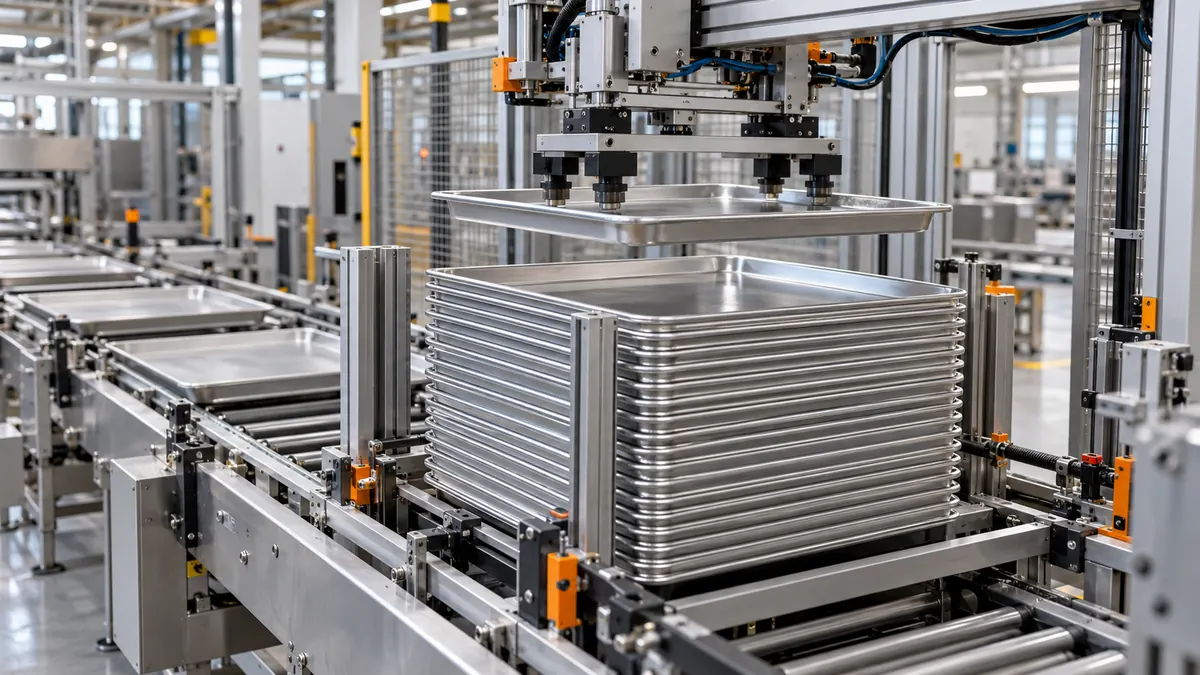
Map the complete pan-handling route
Document every point from depanning and cooling through cleaning, inversion, stacking, storage, unstacking and return to makeup. Identify the equipment supplier, conveyor elevation, travel direction, orientation and available buffer at each interface.
AMF describes pan and lid handling as an integrated cycle, while Rexfab and Weldon publish systems that combine stacking, unstacking, conveying and storage. The bakeware specification therefore needs to cover the complete return loop rather than one isolated machine.
Define the assembled envelope and orientation
Freeze overall length, width, height, flange and frame geometry, center of mass, preferred leading edge and the datum surfaces used by stops, guides and sensors. For strapped sets, specify the finished assembly after joining and coating, not only the individual cavity drawing.
Record every allowed orientation. A pan that enters rotated or inverted can present different pickup surfaces, sensor targets and interference risks, so orientation control belongs in both the equipment recipe and the bakeware approval plan.
Control nesting depth, separation and stack stability
Specify the intended contact points, vertical pitch per pan, maximum stack height, allowable lean and how much clearance remains between adjacent coated surfaces. Nesting stops or frame features should carry the load without wedging, coating rub or cavity deformation.
Test minimum, nominal and maximum conditions using production-intent pans. Include dimensional variation, coating build, burr limits, thermal condition and realistic wear because a stack that works with hand-picked samples may bind or double-pick in production.
Reserve verified pickup and release zones
Identify where magnets, vacuum cups, clamps, forks or robotic grippers may contact the pan. Keep those zones free of ribs, holes, sharp steps, labels and fragile coating transitions unless the handling system is designed for them.
Magnetic handling requires a compatible ferromagnetic pickup path; aluminum pans may need vacuum, mechanical gripping or a designed steel interface. Freeze permissible contact force, lift direction, release clearance and the condition that confirms a single-pan pick.
Set temperature, contamination and drainage limits
State the pan temperature range at stacking and unstacking, including hot restart and cold storage cases. Thermal expansion and temporary distortion can change pitch, flatness, magnetic gap, vacuum seal and stack height.
Define acceptable residue, moisture and separator conditions after cleaning. Drainage direction and dry contact zones matter because water, crumbs, grease or warped separators can make pans stick together, misread a sensor or damage the finish during sliding.
Specify sensors, recipes and changeover evidence
Provide reliable edges, targets or surfaces for presence, height, orientation and double-pick detection. Avoid assuming one sensor technology will read every finish: confirm the real coated, reflective, perforated or dark surface with the automation integrator.
For mixed pan fleets, record recipe name, pan identity, stack quantity, guide positions, pickup offsets, conveyor speed and permitted adjustments. Use keyed or verified setup points so a changeover cannot silently combine the wrong recipe and pan family.
Validate cycle time and fault recovery
Run enough consecutive cycles to expose double picks, missed picks, tilted stacks, jams, coating contact and unstable discharge. Record required pans per minute, allowed micro-stops and the effect of stack replenishment rather than reporting only a best-case machine speed.
Challenge recovery from a skewed pan, partial stack, power interruption and rejected pick. Define safe manual access, held-pan disposition and restart sequence with the equipment supplier; the pan specification should not rely on operators correcting recurring geometry problems.
Approve production-intent pans on the actual line
Use parts made with final tooling, joints, coating and markings. Test empty pans at the relevant temperature first, then run the complete bakery route and inspect pickup zones, rims, frames and coated surfaces for contact damage or progressive distortion.
Freeze the approved pan revision, stack pattern, pallet or cart interface, machine recipe and acceptance record. Require a new line trial after changes to pan geometry, material, coating, joining, nesting stops, pickup hardware, sensors or control logic.
Stacking and Unstacking Approval Matrix
| Interface | Buyer input | Acceptance evidence |
|---|---|---|
| Stack geometry | Pitch, height, lean, contact points and quantity | Measured stack at tolerance limits |
| Pickup zone | Method, location, force, clearance and finish | Single-pick trial with production pans |
| Temperature | Minimum, nominal and maximum pan condition | Hot and cold handling results |
| Sensors | Presence, orientation, stack-height and double-pick logic | Verified detection on every finish |
| Throughput | Required pans per minute and buffer behavior | Sustained run with replenishment |
| Changeover | Recipes, guides, tooling and identification | Timed, error-checked setup trial |
| Fault recovery | Skew, missed pick, partial stack and restart | Safe recovery checklist and record |
Equipment context: AMF Pan & Lid Handling describes integrated robotic and mechanical stacking systems; Rexfab's pan stacker-unstacker documents recipe-driven handling of multiple pan sizes; Weldon pan systems covers stacking, unstacking, conveying and storage. Final specifications must be validated with the selected integrator and production-intent pans.
Frequently Asked Questions
What bakeware data does a stacker or unstacker supplier need?
Provide the finished pan drawing, mass and center of gravity, material, coating, allowed orientations, stack pitch and height, pickup zones, temperature range, rate, current pan condition and representative samples.
Can magnetic unstackers handle aluminum baking trays?
Not through aluminum alone. The system needs another verified method such as vacuum or mechanical gripping, or a designed ferromagnetic interface approved with the equipment supplier.
Why does an automated unstacker pick two pans?
Likely causes include wedging, coating or residue adhesion, excessive nesting, warped rims, separators, pickup force, sensor setup or stack misalignment. Diagnose the combined pan-and-machine interface.
Should hot pans be included in line trials?
Yes when production stacks or handles pans above ambient temperature. Test the defined temperature range because expansion and temporary distortion can affect fit, pickup and stack stability.
How many cycles are needed for acceptance?
Set a representative continuous run based on production rate and risk, including replenishment, changeover and fault challenges. A few successful picks do not demonstrate sustained capability.
Automation Compatibility Review
Make the pan, stack and handling recipe work as one system.
Send the pan drawing, finished mass, material and coating, stack pattern, pickup method, temperature range, required line rate and equipment interfaces for an automation-ready commercial bakeware review.
For production-line heat decisions, use the commercial bakeware thermal mapping and oven profile validation guide to define sensor maps, load boundaries and acceptance criteria.