Blog / Industrial Bakeware Cleaning
Commercial Bakeware for Industrial Pan Washers: A Compatibility Specification Guide
Control pan geometry, drainage, coating limits, chemistry and trials before approving bakeware for an automated washer.
Bakeware China Editorial Team | 2026-09-09 | 10 min read
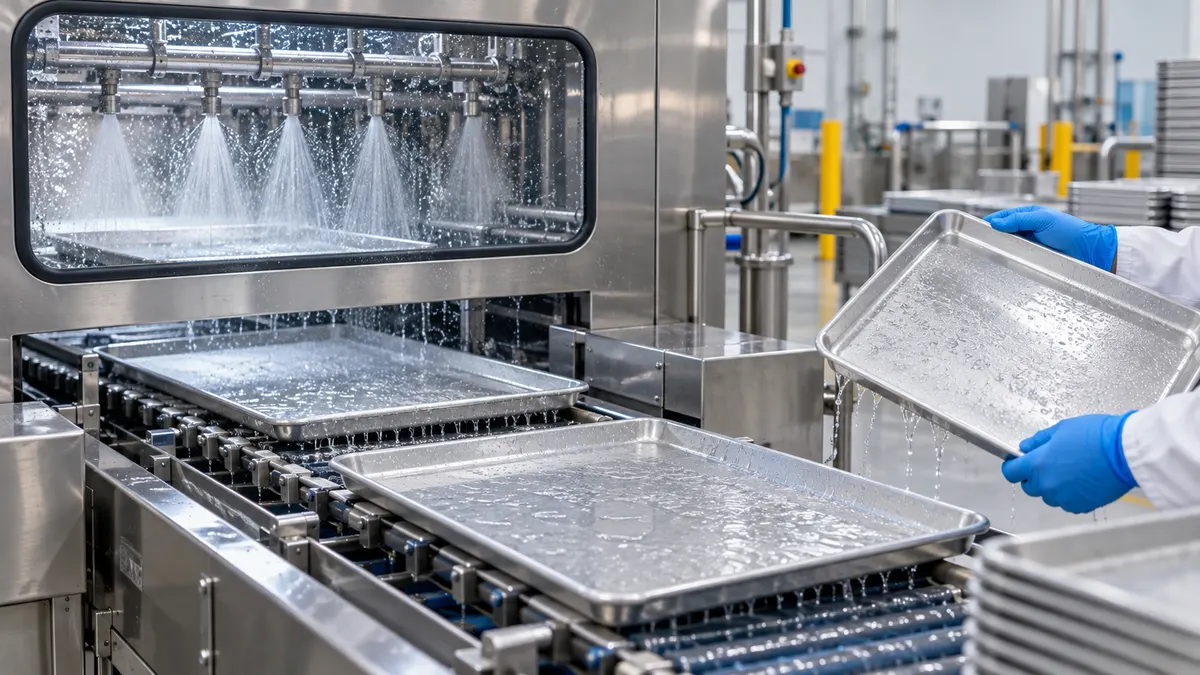
Define the full wash-system route
Map loading, pre-scrape, wash, rinse, sanitation, drying, unloading, stacking and return handling. Record every guide, stop, transfer and support surface that contacts the pan.
Lock the pan envelope and contact geometry
Specify maximum length, width and height, rim profile, frames, straps and protrusions, including tolerances and coated condition.
Design for drainage and carryover control
Review orientation, cavity depth, channels, seams, hollow sections and trapped-water points. Measure residual water after the defined drying stage.
Match material and construction to repeated washing
Confirm substrate, thickness, temper, joints and reinforcement against heat, mechanical loading and approved chemistry using production-intent pans.
Control coating and surface-finish limits
Define approved cleaner, concentration, temperature, exposure and spray conditions. Inspect for release loss, blistering, flaking, exposed substrate and texture change.
Specify chemistry as a controlled process input
Document chemistry family, concentration, water quality, dosing and verification. Require notification when detergent or water treatment changes.
Validate cleaning without over-washing
Define representative soil, hold time, orientation and acceptance methods. Optimize within hygiene, equipment, coating, energy and safety limits.
Run dimensional and functional checks after cycling
Measure critical dimensions before and after agreed wash cycles, then repeat equipment-fit, stacking, depanning and bake-performance checks.
Control loading, unloading and stacking damage
Define stack height, separation, lift points and handling tools. Include transfer damage and jam recovery in validation records.
Build washer compatibility into the RFQ
Provide washer model, route, carrier dimensions, speeds, temperatures, chemistry, drying method, soil and throughput. Require production-intent trials and change control.
Frequently asked questions
Can all commercial non-stick pans go through an industrial washer?
No. Compatibility depends on the exact coating, substrate, construction and process conditions.
How should compatibility be tested?
Run representative dirty-to-dry cycles, then check cleaning, drainage, coating, dimensions, line fit, stacking and bake function.
When should a bakery revalidate?
Revalidate after changes to pans, chemistry, water treatment, temperature, pressure, speed, orientation or equipment.
Request a washer-compatible bakeware review
Send your drawings, washer model, conveyor interfaces, chemistry, temperatures, soil and throughput through our inquiry form.