Bakeware Process Validation
Commercial Bakeware Thermal Mapping and Oven Profile Validation: Buyer Specification Guide
A B2B engineering guide to validating how commercial baking trays, pans and oven settings perform across the real production load.
Start with the production question
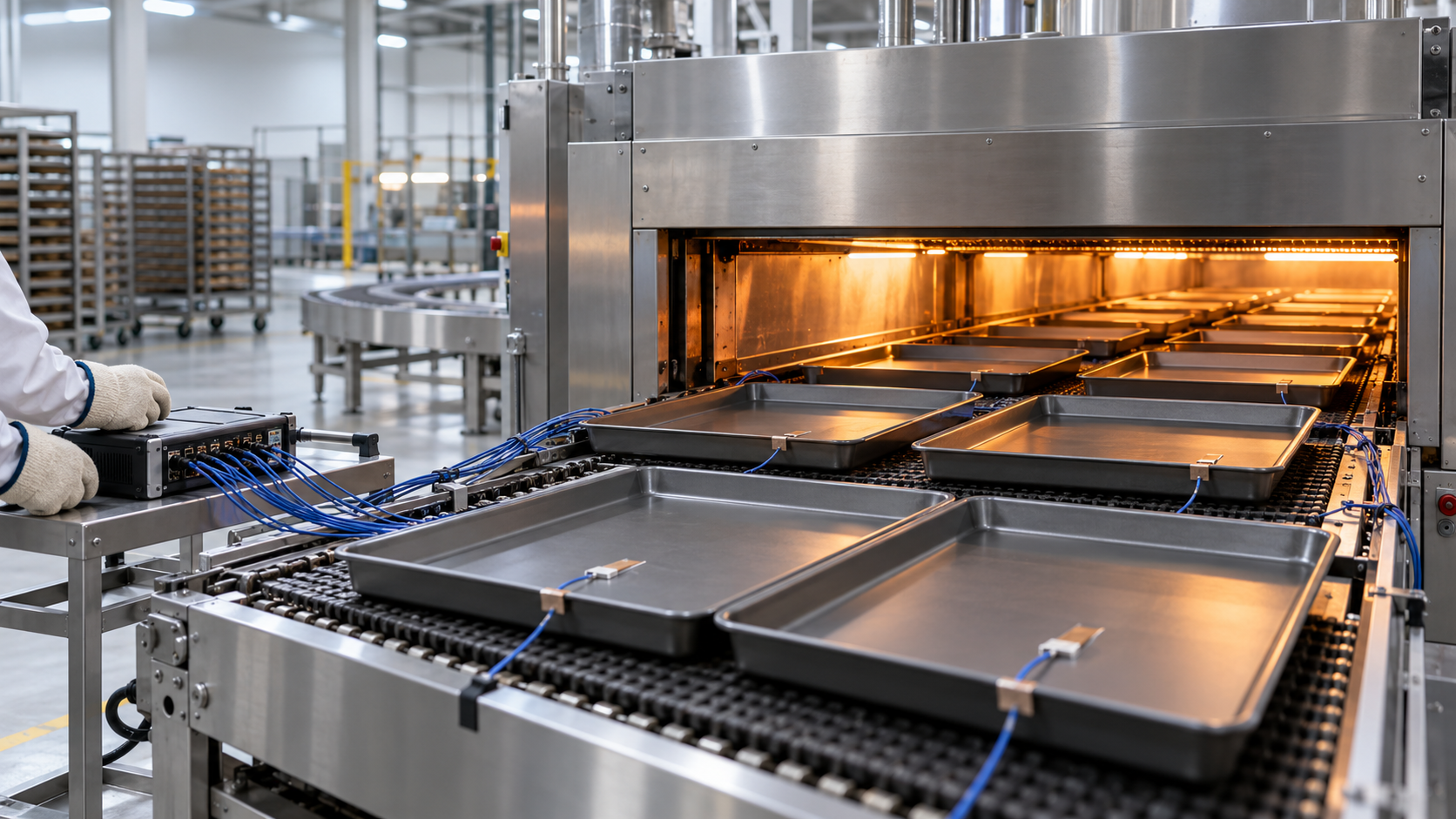
Define what the thermal study must decide: pan material or gauge, cavity geometry, coating, conveyor speed, oven setpoints, product load, bake uniformity, edge-to-center delta or a customer acceptance risk. A buyer should not approve a pan from an empty-oven map when the production load is the variable that changes the result.
Record the product family, target moisture or bake endpoint, line rate, oven zones, belt direction, pan spacing, loading pattern and expected temperature range. These inputs make a thermal result reproducible and let the supplier separate pan effects from oven-control effects.
Map the pan and sensor configuration
Use a controlled drawing to identify pan length, width, depth, base thickness, forming features, perforations, coating and intended orientation. Mark where probes or data-logger clips may be attached without changing airflow, contact or pan handling.
Agree the sensor type, attachment method, channel count, calibration status, sample interval and logger protection before the trial. Keep the same sensor layout for comparison runs unless the change is documented, because moving a probe can create an apparent process improvement.
Set oven zones and load boundaries
Freeze the oven recipe used for the comparison: zone temperatures, fan settings, steam or humidity, belt speed, dwell time, preheat condition and start-up stabilization. Capture actual values when available rather than relying only on HMI setpoints.
Test the approved minimum, nominal and maximum load patterns. Include edge positions, center positions, leading and trailing pans, and any recirculation or gap condition that production can create. A buyer should know which load boundary the supplier is warranting.
Compare pan constructions fairly
When comparing aluminum, aluminized steel, stainless or coated variants, keep product, oven recipe, pan count, spacing, sensor map and handling state constant. Record pan age, cleaning history and coating revision; a new pan and a worn pan are not equivalent thermal samples.
Separate warm-up behavior, steady-state behavior and recovery after a door or line interruption. Note whether the pan reaches equilibrium with the belt and product or carries a transient temperature that affects the first cycles after a changeover.
Define acceptance criteria before testing
Turn “even baking” into measurable limits: maximum sensor spread at steady state, edge-to-center difference, repeatability across cycles, time within the target band and product outcome at the agreed sampling points. Do not hide an unstable process behind one average temperature.
Set criteria for sensor loss, logger dropout, pan damage, coating contact, belt tracking and out-of-range loads. Include who owns a retest when the oven is out of control, a pan is misloaded or the product recipe changes.
Use production-intent validation runs
Run enough consecutive cycles to cover warm-up, steady state, replenishment and the normal changeover sequence. Use production tooling, final pan finish, representative product and the intended line speed; lab coupons and hand-loaded samples can only screen concepts.
Retain raw channel data, oven settings, pan identity, product lot, load map, timestamps and deviations. Summaries should show min, max, mean, spread and repeatability by position, not only a selected “best” trace.
Link thermal results to procurement decisions
A thermal map should lead to a controlled decision: approve a pan revision, adjust the oven recipe, narrow a load range, add a line guide, or reject the sample. Record the decision and the evidence in the purchase specification or first-article file.
Ask suppliers to identify what is fixed and what is process-dependent. A pan manufacturer can control material, geometry, coating and flatness, but the bakery still controls product, oven maintenance, belt condition, loading and cleaning.
Lock change control and revalidation
Require a new review after changes to pan thickness, alloy, coating, tooling, perforation, rim, oven zone hardware, fan recipe, conveyor speed or product load. Define whether a delta study or a full thermal map is required.
Keep an approved thermal map with the pan revision and line recipe. Revalidate after a repeated drift signal, unexplained bake variation, major maintenance or a supplier change, and make the result available to quality, production and procurement teams.
Thermal Mapping and Profile Approval Matrix
| Control area | Buyer input | Acceptance evidence |
|---|---|---|
| Pan construction | Material, gauge, geometry, coating and revision | Controlled drawing and sample identity |
| Sensor map | Probe locations, attachment, channels and calibration | Traceable raw data and placement map |
| Oven recipe | Zones, airflow, belt speed, dwell and stabilization | Actual settings and recorded deviations |
| Load boundary | Spacing, edge/center positions and min/nominal/max load | Repeatable runs at stated boundaries |
| Thermal criteria | Spread, band time, repeatability and retest rules | Signed report with min/max/mean and disposition |
| Change control | Trigger events and delta/full-map decision | Revalidation record linked to pan revision |
Validation note: thermal results are process-specific. Confirm the final pan, oven and product combination with calibrated equipment, controlled records and the selected bakery line before release.
Frequently Asked Questions
What is thermal mapping for commercial bakeware?
It is a documented measurement of temperatures across specified pan and product positions during a controlled production process, used to compare constructions and confirm load-specific acceptance criteria.
Is an empty-oven profile enough to approve a baking pan?
No. Empty-oven data can screen a concept, but approval should include the defined product, pan spacing, load and line recipe because the production load changes heat transfer and recovery.
How many probes should a buyer specify?
Use enough calibrated channels to cover edge, center, leading, trailing and any known risk zones. The required count depends on pan size, oven width, load pattern and the decision being made.
Can a supplier guarantee one temperature spread for every bakery line?
Usually not. Results depend on oven design, recipe, load, product, belt condition and maintenance. Require claims to state the tested construction and process boundaries.
When should thermal mapping be repeated?
Repeat after changes to pan construction, coating, tooling, oven recipe, belt speed, load pattern or product, and when production data shows drift outside the approved limits.
Thermal Validation Review
Connect the pan specification to the real oven load.
Send the pan drawing, material and coating revision, oven zones, belt speed, load pattern and target bake window for a thermal-validation review.