Commercial Bakeware Quality
Commercial Bakeware Coating Life: Wear Criteria and Replacement Planning
Specify coating life by the real bakery route, with measurable wear limits, inspection evidence and planned replacement triggers.
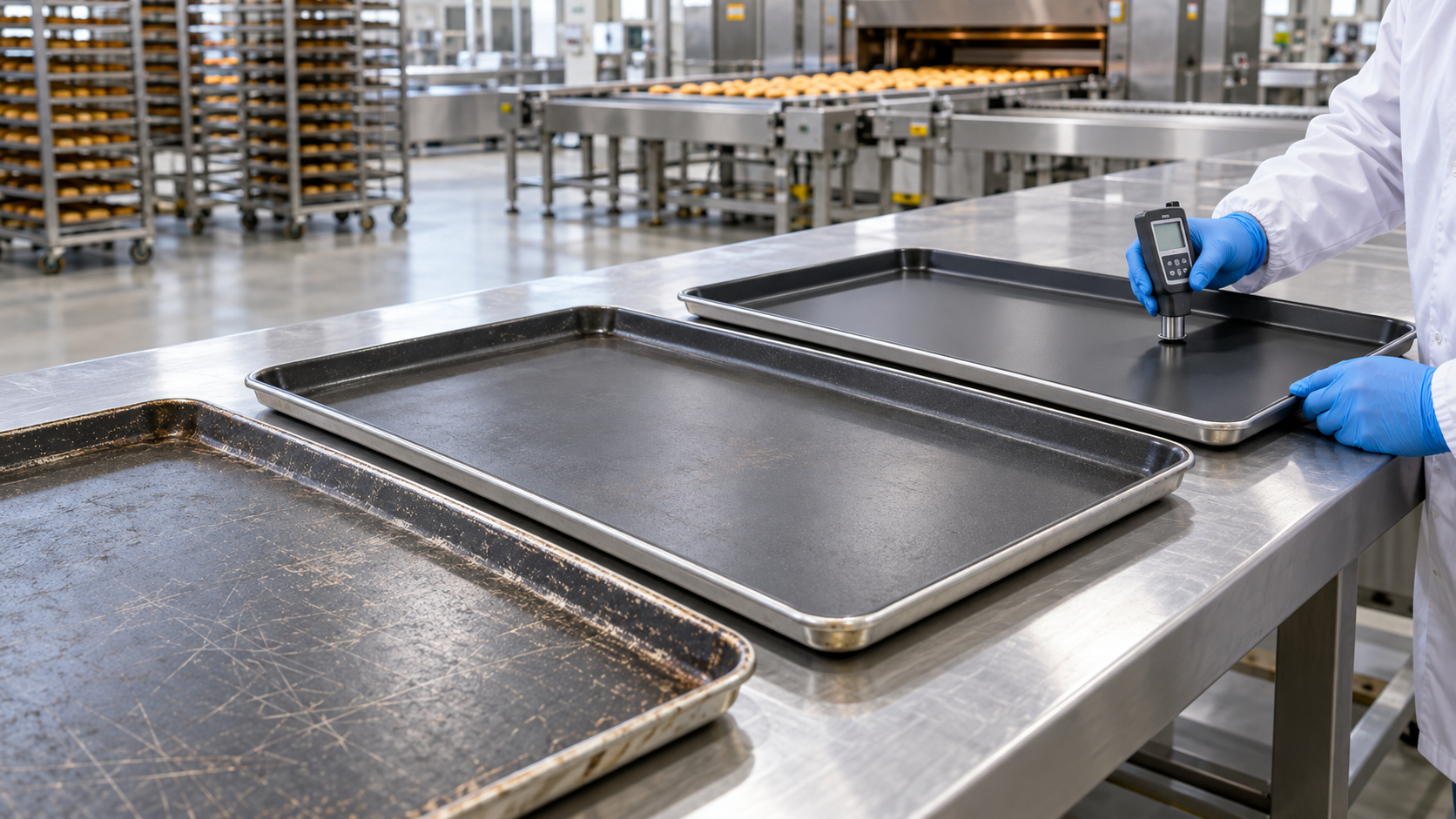
Start with the bakery duty cycle
Coating life depends on temperature, dwell time, release agents, product sugars, depanning tools, wash chemistry, drying and nesting abrasion. Describe the actual route before comparing suppliers or quoting a cycle number.
Separate oven exposure from the full service route. A tray may survive heat testing yet fail earlier because of scraping, aggressive washing or repeated nesting.
Define what “life” means for the buyer
Set measurable endpoints such as release performance, visual wear, coating adhesion, surface roughness, corrosion protection, cleanability and food-contact compliance. A pan can look acceptable while release force or cleaning time has already drifted.
Tie each endpoint to a decision: continue using, inspect more frequently, downgrade to a non-critical product, quarantine or replace.
Freeze the coating and substrate specification
Record coating family, number of layers, target thickness range, cure profile, substrate alloy or steel grade, edge treatment and approved color or gloss. Ask for production-intent samples with the same forming and masking details as the order.
Do not approve a coating by color alone. Two finishes can look similar while differing in release, abrasion resistance and wash compatibility.
Build a route-representative validation plan
Use representative dough or batter, release agents, oven temperatures, wash chemistry, mechanical handling and nesting. Inspect at planned intervals and keep before-and-after photographs, release observations and dimensional checks.
Include the equipment operators who will judge sticking and cleaning. Their observations should be converted into a controlled scorecard rather than informal comments.
Set practical wear and replacement criteria
Define unacceptable damage: exposed substrate, flaking, sharp edges, deep scratches, blistering, corrosion, persistent sticking, contamination retention or a failed food-contact requirement. Set clear inspection lighting, cleaning state and sampling frequency.
Replacement planning works best when criteria are linked to asset IDs or batches. This lets a bakery remove only the affected group instead of stopping every tray in the same family.
Plan ownership, records and replenishment
Keep the approved coating data, validation report, inspection photos, wash chemistry, purchase order, lot and replacement decision together. Require suppliers to notify the buyer before changing coating chemistry, cure process, substrate or production site.
Use service history to forecast replenishment. A buyer can then order a controlled replacement quantity before release defects create production downtime.
Coating-Life Approval Gate
| Gate | Buyer defines | Evidence to retain |
|---|---|---|
| Duty cycle | Oven, wash, handling, nesting and product route | Route description and risk notes |
| Coating system | Family, layers, thickness, cure and substrate | Approved drawing and production sample |
| Performance | Release, cleanability, adhesion and food-contact criteria | Validation scorecard and test records |
| Wear trigger | Damage, sticking, residue, corrosion or safety limit | Inspection photos and disposition |
| Replenishment | Asset/batch records and lead-time trigger | Replacement forecast and change notice |
Use the buyer’s own quality, wash, food-contact and destination-market requirements as the final acceptance authority.
Frequently Asked Questions
How many cycles should a commercial bakeware coating last?
There is no universal number. Validate the exact coating, substrate and bakery route, then publish a buyer-specific inspection interval and replacement trigger.
What is the first sign that a pan coating is failing?
Release force, sticking and cleaning time may worsen before obvious peeling appears. Track operating observations alongside visual inspection.
Can a scratched non-stick tray remain in service?
Only if the buyer’s documented risk assessment allows it and the scratch does not expose substrate, create sharp edges, retain residue or fail food-contact requirements.
Should coating thickness be specified in an RFQ?
Yes. State the target range, measurement method, sample location and acceptance evidence together with coating type and cure requirements.
How should suppliers report coating changes?
Require advance notice for chemistry, layer structure, cure, substrate, masking, color or production-site changes, with sample and revalidation requirements.
Instant Quote
Plan coating life before release defects.
Send the tray drawing, substrate, coating target, oven and wash route, product release expectations and planned quantity. Bakeware China can turn them into a coating-life RFQ, validation matrix and replenishment plan.
For production-line heat decisions, use the commercial bakeware thermal mapping and oven profile validation guide to define sensor maps, load boundaries and acceptance criteria.
For hygienic drainage and drying criteria, use the commercial bakeware drainage and drying guide.