Blog / Bakeware Export Packaging
Commercial Bakeware Export Packaging: A Buyer Specification Guide
Turn shipment risks into measurable surface protection, carton, pallet, labeling and receiving controls.
Bakeware China Editorial Team | 2026-08-28 | 9 min read
Start with the product and distribution route
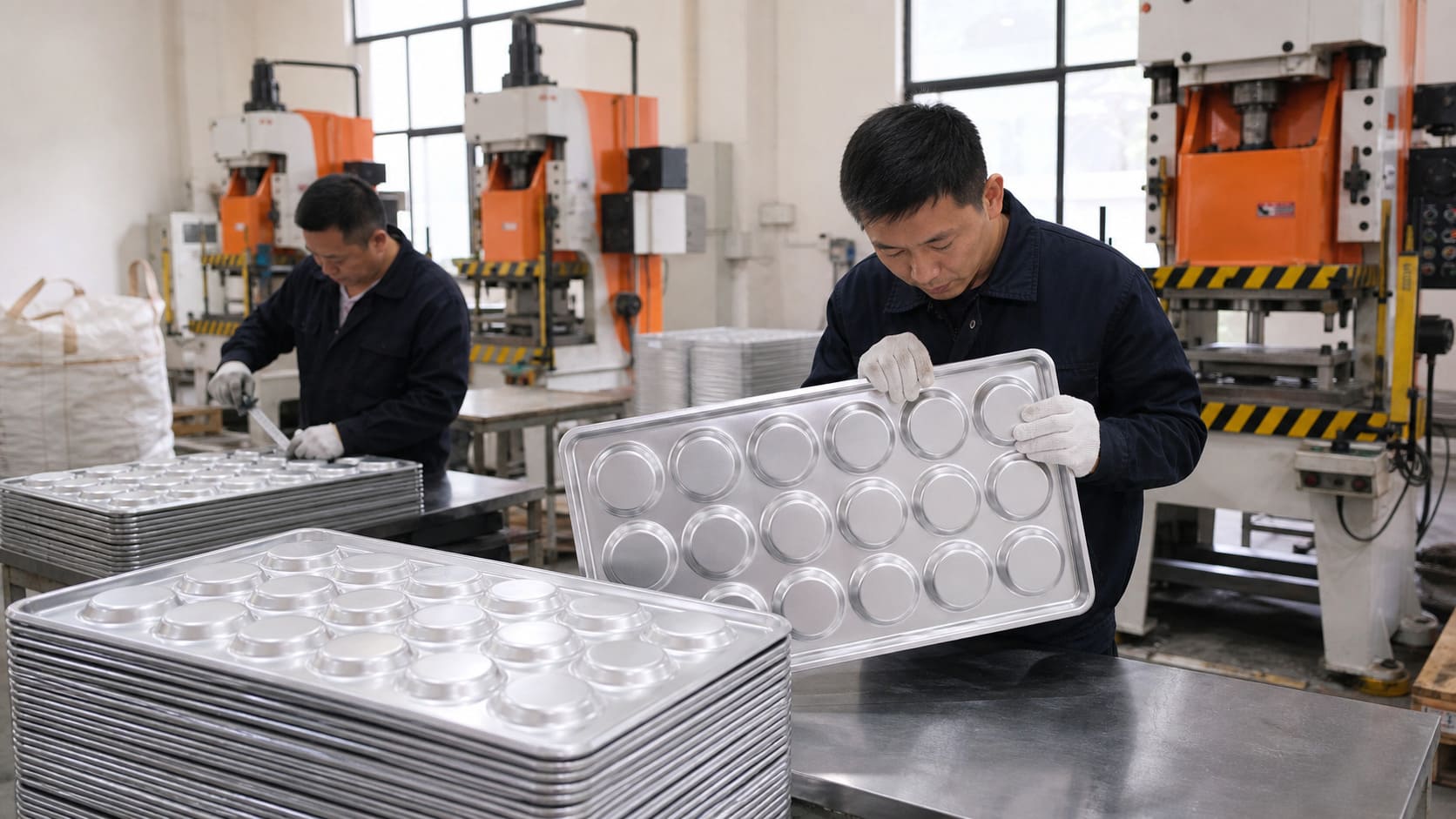
Commercial bakeware export packaging should begin with the product, not a generic carton. Record the pan or rack type, dimensions, finish, loose or strapped construction, nesting pattern, units per shipment and gross mass. Coated pans, sharp perforated trays, framed bun pans and wire racks present different contact and restraint risks.
Map the route from final inspection through warehouse handling, container loading, transshipment, destination storage and customer receiving. State shipment mode, pallet exchanges, expected handling points and any justified temperature or humidity controls. Approve packaging against the actual SKU and route instead of copying a pack used for another product.
Protect every product-to-product contact surface
Draw a contact map for nested rims, bases, cavities, wires, frames, handles and coated faces. When relative movement could mark a saleable or functional surface, specify a clean separator, sleeve, bag, corner guard, cap or rigid divider. Define material, size, placement and count rather than requesting only “protective packing.”
Protection materials should not introduce grit, moisture, adhesive transfer or concentrated pressure. Food-contact surfaces should arrive clean and protected under the agreed specification, but packaging alone does not establish food-contact compliance. Use the food-contact document guide for material and coating evidence.
Control nesting, stack height and unpacking
Nesting saves volume but can transfer load through rims, sidewalls or coatings. Define orientation, units per stack, separator position, maximum stack height and lifting points. If close-fitting pans can bind, include a practical removal method that does not require prying against a coated edge.
Run a production-representative pack-and-unpack trial. Record scratches, coating rub, deformation, trapped separators, unstable stacks and operator access. A visual check immediately after packing does not show what happens after normal handling, so retain the approved packed sample or clear photographs for production control.
Specify the complete filled carton
State the carton style, inside dimensions, board or performance requirement, closure method, internal supports, units per carton and maximum gross mass. Avoid approving only an empty carton sample: the complete filled package determines whether loads reach product rims, pan cavities or rack wires.
Internal restraints should limit movement without concentrating force. Dividers and pads must stay in position during handling. Define how cartons are closed and whether staples, tape or straps are permitted near the product. Add count, orientation and closure checks to the commercial bakeware quality inspection plan.
Engineer the palletized load
For palletized shipments, specify pallet footprint, carton pattern, permitted overhang, total height, gross load, corner boards, top protection, stretch wrap or straps, and forklift entry. Record whether cartons can carry vertical compression or require a load-spreading structure.
Validate stability for the intended handling route. Excessive strap tension can deform rims or cartons, while loose restraint can allow abrasion and load shift. Terms such as export-worthy or seaworthy are not measurable substitutes for a drawing, packing bill, test plan and acceptance criteria.
Check destination rules for wood packaging
ISPM 15 addresses phytosanitary risk from raw-wood packaging used in international trade, including pallets and dunnage. The IPPC states that processed wood made in a way that removes pest risk, such as plywood, is outside the standard's scope. It also notes that ISPM 15 measures are not intended to provide ongoing protection from later contamination.
Destination rules still need confirmation for each shipment. When regulated wood packaging is used, require treatment and an official mark applied by an authorized provider. For U.S.-bound cargo, USDA APHIS instructs importers to ensure regulated wood packaging is pest-free, debarked, treated and properly marked. A bakeware supplier should not invent, copy or self-apply an authorization mark.
Build a route-based package test plan
ISO 4180:2019, confirmed current by ISO in 2025, establishes general rules for compiling performance-test schedules for complete, filled transport packages in distribution systems other than dangerous goods. It does not prescribe one universal bakeware test or guarantee damage-free delivery.
Select conditioning, compression, vibration, impact or other tests and severity from the actual package, route, load and failure risk with qualified packaging or logistics expertise. Define sample preparation, sequence, acceptance criteria and reporting. If a supplier reports a pass, request the tested package configuration and result rather than accepting an unsupported transit-tested statement.
Make labels and records traceable
Link each carton and pallet to purchase order, SKU, product description, drawing revision, finish, quantity, lot and destination. Add gross and net mass, dimensions, handling marks, country-of-origin information and barcodes only as required by the agreed commercial and destination-market specification.
Control label and private-brand artwork revisions before printing. A readable label cannot correct an incorrect SKU or quantity, so reconcile packing lists with physical counts. The OEM and private label bakeware page explains how branding inputs should stay connected to approved product and packaging records.
Inspect packaging before shipment and at receipt
Before release, inspect product count, nesting orientation, separators, bags, carton closure, pallet pattern, restraints, labels and visible damage. Photograph representative cartons and the finished pallet from defined views. Record deviations and disposition instead of repairing packaging without traceability.
At receiving, photograph external condition before unpacking, record any wet, crushed, punctured or shifted areas, and preserve shipment and lot identity. Sample protected surfaces, dimensions and quantity under an agreed plan. Define notification timing, evidence, segregation and claims handling in the purchase agreement; packaging reduces risk but cannot guarantee every delivery.
Freeze the packaging specification for repeat orders
Packaging is part of the approved product supply, not an informal warehouse choice. Require notice before changes to separator, bag, carton, pallet, supplier, dimensions, packing count, closure, label, stacking or restraint. Review whether any change needs a new packed sample or route test.
Attach the approved packaging specification to the commercial bakeware RFQ template and purchase order. Include photos or drawings, bill of materials, packing sequence, inspection method, test criteria and document retention. This makes quotations more comparable and prevents a cost change from silently changing product protection.
Commercial bakeware export packaging checklist
Provide the product drawing and finish; nesting and contact map; protection materials; carton construction and count; gross mass; pallet drawing; restraints; route and destination; applicable wood-packaging requirement; test schedule; labels; pre-shipment inspection; receiving checks; claims process and change control. Buyers should approve the complete packed SKU, not isolated components.
Frequently asked questions
What should a commercial bakeware packaging specification include?
Include nesting orientation, contact protection, separators, bags, carton construction, packing count, gross mass, pallet pattern, restraints, labels, route-based tests, inspection and change control.
How can buyers reduce scratches on coated bakeware in transit?
Map every contact point, use clean compatible separation materials, control stack height, restrain movement and approve a representative pack-and-unpack trial with measurable acceptance criteria.
Does every export pallet need an ISPM 15 mark?
No. Scope and destination rules matter. ISPM 15 addresses raw-wood packaging; processed-wood and non-wood alternatives may fall outside its scope. Confirm current destination requirements.
Can a carton specification guarantee damage-free delivery?
No. Packaging reduces defined risks but cannot guarantee every shipment. Use route-based validation, inspection records and an agreed receiving and claims process.
What should remain fixed on repeat packaging orders?
Control protection materials, dimensions, suppliers, packing count, nesting, closures, pallet pattern, restraints, labels, test criteria and change notification.
Request a packaging-ready commercial bakeware quotation
Send your bakeware type, finish, dimensions, nesting limits, order quantity, destination, shipping mode, labeling requirements and receiving criteria. Bakeware China can review the product and packaging inputs for a commercial quotation. Use our inquiry form.
For cross-supplier comparison, use the commercial bakeware landed-cost guide to normalize freight, duty, quality and inventory assumptions.