Blog / Commercial Cooling Rack Sourcing
How to Specify Commercial Cooling Racks for Bakery Production
Build an inspection-ready commercial cooling rack specification around the food, process, supporting equipment, wire layout, construction and representative trials.
Bakeware China Editorial Team | 2026-08-14 | 9 min read
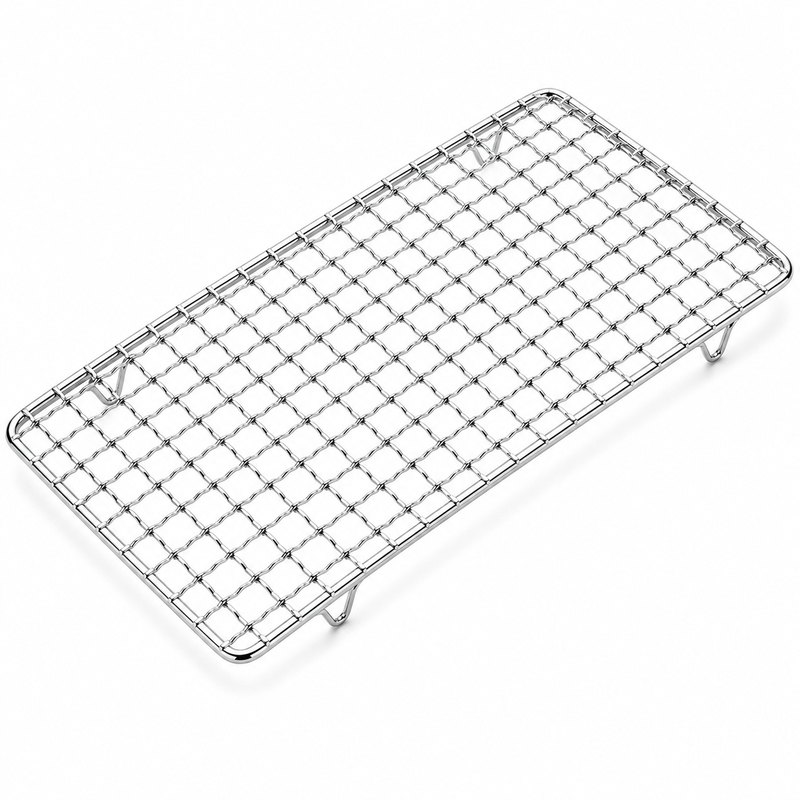
Define the cooling task before selecting a rack
Start the RFQ with the product: bread, buns, cakes, cookies or another item; its dimensions and mass range; whether it arrives in a pan or is depanned; product temperature at loading; cooling time target; and the next transfer or packaging step. State whether the wire rack sits on a tray, slides into a trolley, rides a conveyor or forms part of a manual workstation.
Cooling performance depends on the product, loading pattern, ambient conditions, airflow and dwell time as well as the rack. Set measurable trial criteria for product support, marking, sticking, transfer and cooling uniformity instead of asking a supplier to guarantee one result from rack geometry alone.
Freeze the outside envelope and equipment interfaces
Put overall length, width, height, corner radii, frame profile and permitted projection on a controlled drawing. Mark the loading direction, reference datums and contact zones for rails, trays, belts, stops, guides, lifters, stackers and operators. If the rack nests inside a sheet pan, define usable pan dimensions and corner clearances rather than relying on a nominal pan name.
For trolley use, record runner width, pitch, stops and clear opening, and compare them with the bakery rack trolley specification guide. Equipment-maker drawings should control interfaces. A standard-size label cannot establish fit across different ovens, coolers, washers or conveyor systems.
Specify wire diameter, spacing and orientation
Define the nominal wire diameter, center-to-center spacing, clear opening and wire direction. Show whether the layout is parallel, crossed or mesh, and identify solid borders or zones reserved for supports and transfers. Small or soft products may require closer support; heavy or hot products may require a different structure. The choice must be validated with the intended load.
State how cut ends are finished and where welded intersections may contact food, trays or handling equipment. Require drawings to identify perimeter wire, cross supports and attachment points. Terms such as heavy duty, tight grid or commercial grade are not substitutes for measurable geometry.
Define frame construction and support conditions
Specify the perimeter frame section, number and position of crossbars, feet or stand-offs, handle zones and stacking features. Record how the rack is supported during loading, cooling, washing and storage. A rack supported on four corners behaves differently from one supported continuously by a pan, trolley runners or conveyor rails.
Give the supplier the maximum actual product load and distribution pattern, but do not accept an unverified load rating. Agree a test fixture, load placement, duration and acceptance criteria for permanent deformation, weld condition and interface fit. Repeat the test on production-representative samples where the application is critical.
Select material and finish for the real use
Define base metal or alloy, wire and frame grades, surface finish, welded construction and any plating or coating. State the food type, contact temperature and duration, humidity or condensation, cleaning chemicals, washer temperature, utensils and storage conditions. Use the stainless steel rack and coated wire rack pages only as starting points.
The FDA food-contact reference tables distinguish bakery products, free fat or oil and conditions of use. EU Regulation (EC) No 1935/2004 covers materials intended to contact food and includes traceability requirements. These references do not certify an unspecified rack. Request evidence for the exact material, finish, food, temperature and destination market.
Design for cleaning, drainage and inspection
Map the cleaning route: manual wash, soak, spray cabinet or conveyor washer. Specify allowed chemistry, concentration, temperature and mechanical action. Review wire crossings, frame joints, feet and attachments for accessible cleaning and drainage. Identify orientations that can trap water or residue and include them in the sample review.
Define how cleanliness will be assessed after a representative soil and wash cycle. Visual checks alone may not satisfy every food-safety plan, so the bakery should align acceptance methods with its own hazard analysis and sanitation program. The supplier should not claim hygienic performance without an agreed design review and validation method.
Validate handling and line safety
Run a production-representative rack through loading, transfers, cooling, unloading, washing, stacking and storage under normal safe procedures. Check snag points, sharp edges, unstable stacking, unexpected movement, product support, manual grip zones and every contact with conveyors or trolleys.
OSHA 29 CFR 1910.263 applies to machinery and equipment used in bakeries within its scope and includes machine-guarding and conveyor provisions. A new rack or trial does not authorize bypassing a guard, stop device or site procedure. Confirm changes with the equipment owner and bakery safety team.
Create inspection and repeat-order controls
List critical dimensions and tolerances: outside envelope, flatness, wire diameter and spacing, frame position, feet, handles and interface points. State the measurement fixture, sampling frequency and whether dimensions apply before or after plating or coating. Add workmanship criteria for burrs, exposed wire ends, weld condition, contamination, finish coverage and packaging protection.
Link every order to the approved drawing and sample. Require lot identification and written notice before changes to wire or frame material, diameter, spacing, welding, tooling, plating or coating, manufacturing location, cleaning process or packaging. Revalidation should follow any change that can affect food contact, fit or handling.
Build a complete commercial cooling rack RFQ
Attach the product and cooling brief, controlled drawing, supporting-equipment interfaces, material and finish requirements, cleaning conditions, food-contact document list, sample protocol and inspection plan. Include sample and production quantity, destination, packing method, shipping terms and target schedule.
Use the commercial bakeware supplier checklist to compare evidence and change control. For a nonstandard envelope, grid or frame, send drawings through the custom cooling racks page so assumptions can be resolved before tooling or production.
Frequently asked questions
What information is needed to quote commercial cooling racks?
Provide the product and process, rack drawing, supporting equipment, load pattern, wire grid, frame, material, finish, cleaning method, quantity, destination and inspection requirements.
What wire spacing is best for a bakery cooling rack?
There is no universal spacing. Choose it from product size and softness, load, transfer method, cleaning access and a representative production trial.
Is stainless steel always required?
No single material suits every use. Select and document the material and finish from food-contact conditions, corrosion exposure, cleaning, temperature, structure, market requirements and verified evidence.
Can a supplier guarantee cooling time from the rack design?
Not responsibly without a defined system test. Product, loading, airflow, ambient conditions and dwell also affect cooling, so approve results in the intended process.
What should be controlled on repeat orders?
Control drawing revision, dimensions, wire and frame material, grid, welding, finish, workmanship, packaging, lot identification and change notification.
Request a cooling rack specification review
Planning a bakery cooling station or replacing a rack fleet? Send your product, process, rack or equipment drawings, load pattern, material and finish requirements, cleaning method, quantity and destination market for a specification review and quotation. Use our inquiry form.